
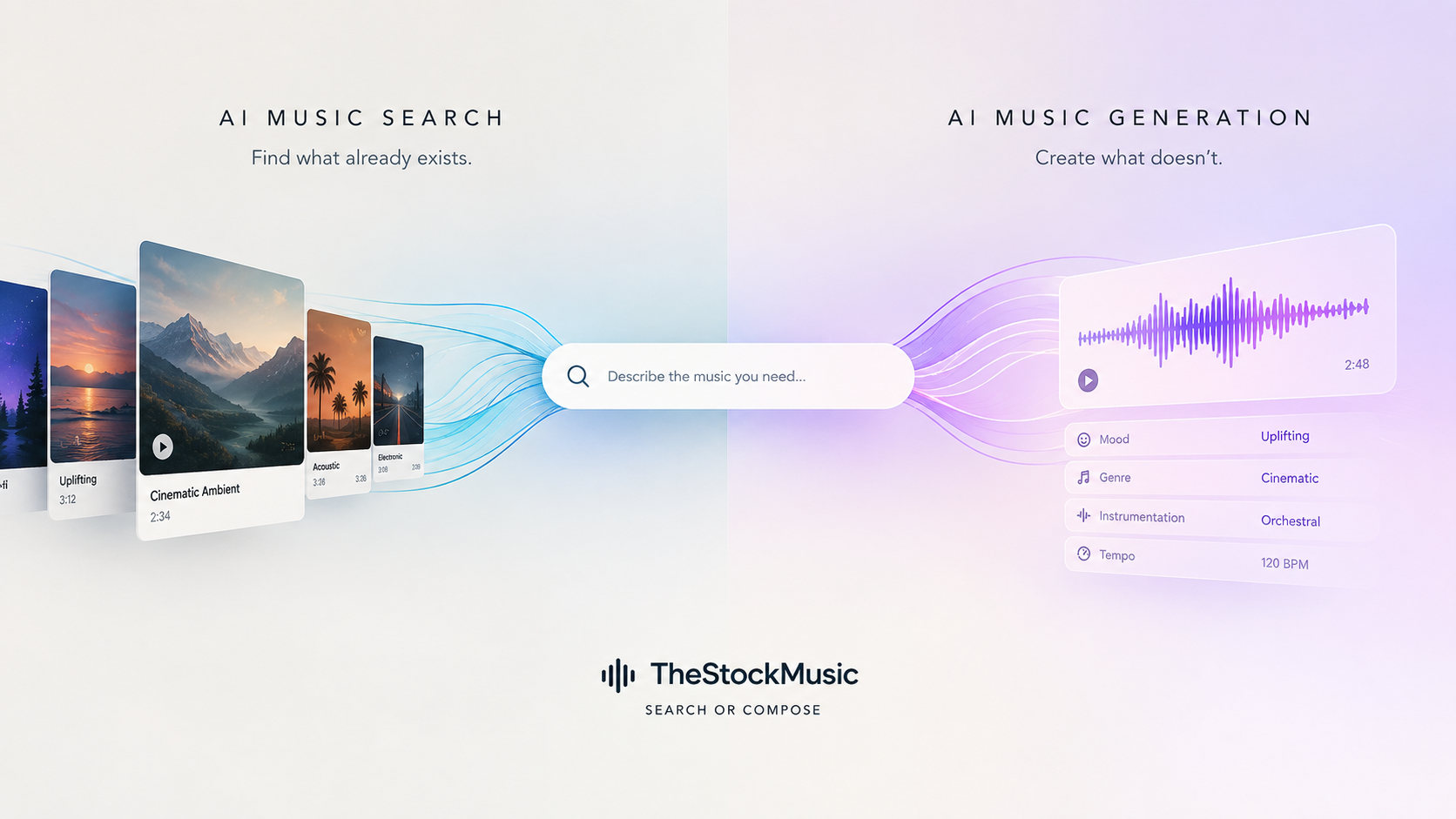
When you need music for a video, podcast, advertisement, game, or social post, there are two fundamentally different ways to get it.
You can search for music that already exists.
Or you can generate music that does not exist yet.
Both approaches can get you to a usable track, but they solve different problems. And the distinction becomes especially useful when a music platform can move between the two instead of forcing you to choose one before you even start.
AI Music Search: Finding the Right Track
AI music search is still a search problem.
The music already exists in a catalog. Your job is to find the track that fits your project.
Traditional music libraries usually make this possible through filters and metadata such as:
- Genre
- Mood
- Tempo
- Instrument
- Duration
- Vocal or instrumental
- Theme or use case
AI can make this process more flexible by allowing you to describe what you actually need.
Instead of searching for:
"cinematic piano"
you might describe:
"A restrained piano track for a reflective scene where the character is leaving home, gradually becoming more hopeful."
That distinction matters because creative briefs are rarely written in tags.
You think about what the scene needs, not necessarily which keywords a music library happened to attach to a track.
AI-powered search can interpret that description and use the meaning of the request to surface relevant music from an existing catalog.
The important point is that AI search does not have to create anything. Its job is to find the closest existing answer.
AI Music Generation: Making the Track When It Doesn't Exist
AI music generation starts from the opposite direction.
Instead of asking:
"Which existing track fits this?"
you ask:
"Can you make a track that fits this?"
A generative music system creates new audio based on inputs such as mood, instrumentation, genre, structure, tempo, or other creative direction.
That makes generation particularly useful when the brief is unusually specific.
Maybe you need:
- A tense instrumental that builds for exactly the final 30 seconds of a trailer.
- A minimal electronic bed that leaves space for narration.
- A warm acoustic piece for a particular brand story.
- A background track with a very specific emotional progression.
If an existing catalog track gets close but not quite there, generation changes the question. You are no longer limited to what someone has already produced.
But generation introduces its own workflow.
You create something, listen, adjust the description, generate again, compare versions, and continue until the result fits.
So while search can involve browsing, generation can involve iteration.
Why Most Music Tools Separate the Two
Search and generation have traditionally been built around different systems.
A music library starts with a finite collection of finished tracks. The challenge is helping you retrieve the right one quickly.
A generative music platform starts with a model capable of producing new audio. The challenge is helping you describe what you want and refine the result.
That creates two familiar workflows:
Search → Find → Preview → Use
or
Describe → Generate → Review → Regenerate → Use
The problem is that creators do not always know which workflow they need at the beginning.
You might search for ten minutes before realizing that the exact track you imagined simply isn't in the catalog.
Or you might start generating music when an existing track would have solved the problem immediately.
The real decision is often not search or generation.
It is:
"Does the right track already exist?"
The More Useful Model: Search First, Generate on the Miss
This is where the distinction between AI music search and AI music generation becomes particularly interesting.
Imagine putting both capabilities behind the same search box.
You describe the music you need.
The system first searches the existing catalog for a meaningful match.
If it finds one, you use it.
If it doesn't, the workflow doesn't stop with:
"No results found."
Instead, the missing result becomes a generation request.
Search → Match
No match → Compose
That turns the usual search failure into a creative next step.
And it removes a decision that creators shouldn't necessarily have to make upfront.
You don't have to decide whether your project is a "stock music project" or an "AI generation project." You simply describe the musical requirement and let the workflow determine whether an existing track or a newly composed one makes more sense.
This Is the Idea Behind TheStockMusic
TheStockMusic is built around this search-or-compose workflow.
You describe the sound, mood, or moment you need, and the platform searches its catalog using the full description of each track rather than relying only on conventional tags. If there is no suitable match, it can compose an original instrumental instead.
That creates a simple progression:
Describe → Search → Match
Describe → Search → No Match → Compose
The distinction is small on paper, but meaningful in practice.
A catalog is useful because there is no reason to generate something new when an existing track already fits.
Generation is useful because a catalog, no matter how large, cannot contain every possible combination of mood, instrumentation, pacing, and creative intent.
Putting the two together means the creator does not have to treat the catalog as a wall.
What This Means for Creators
The biggest benefit is not simply having access to more music.
It is having fewer dead ends.
If the right track already exists, you can find it.
If it doesn't, you have another path without leaving the workflow and starting over in a completely different tool.
That can be especially useful when working under a deadline. A video editor may begin with a vague musical idea, discover an existing track that works, and move on. Another project may require something much more specific, in which case generation can fill the gap.
There is also a practical licensing consideration. TheStockMusic describes its catalog and generated instrumental music as royalty-free and cleared for commercial use, with a license certificate provided on downloads. The exact rights for any music platform should always be checked against its current license terms rather than assumed from the fact that music is AI-generated.
AI Music Search and AI Music Generation Aren't Really Opposites
Search and generation answer different questions.
AI music search asks:
"Does something suitable already exist?"
AI music generation asks:
"Can something suitable be created?"
The more interesting workflow is what happens when those questions become part of the same process.
Instead of searching until you settle, or generating until you get lucky, you can start with the creative brief and let the workflow branch from there.
Sometimes the answer is already in the catalog.
Sometimes it needs to be composed.
Either way, the creator starts from the same place:
Describe what the moment needs.
That is the idea behind TheStockMusic's search-or-compose approach: music discovery does not have to end when search runs out of answers.