
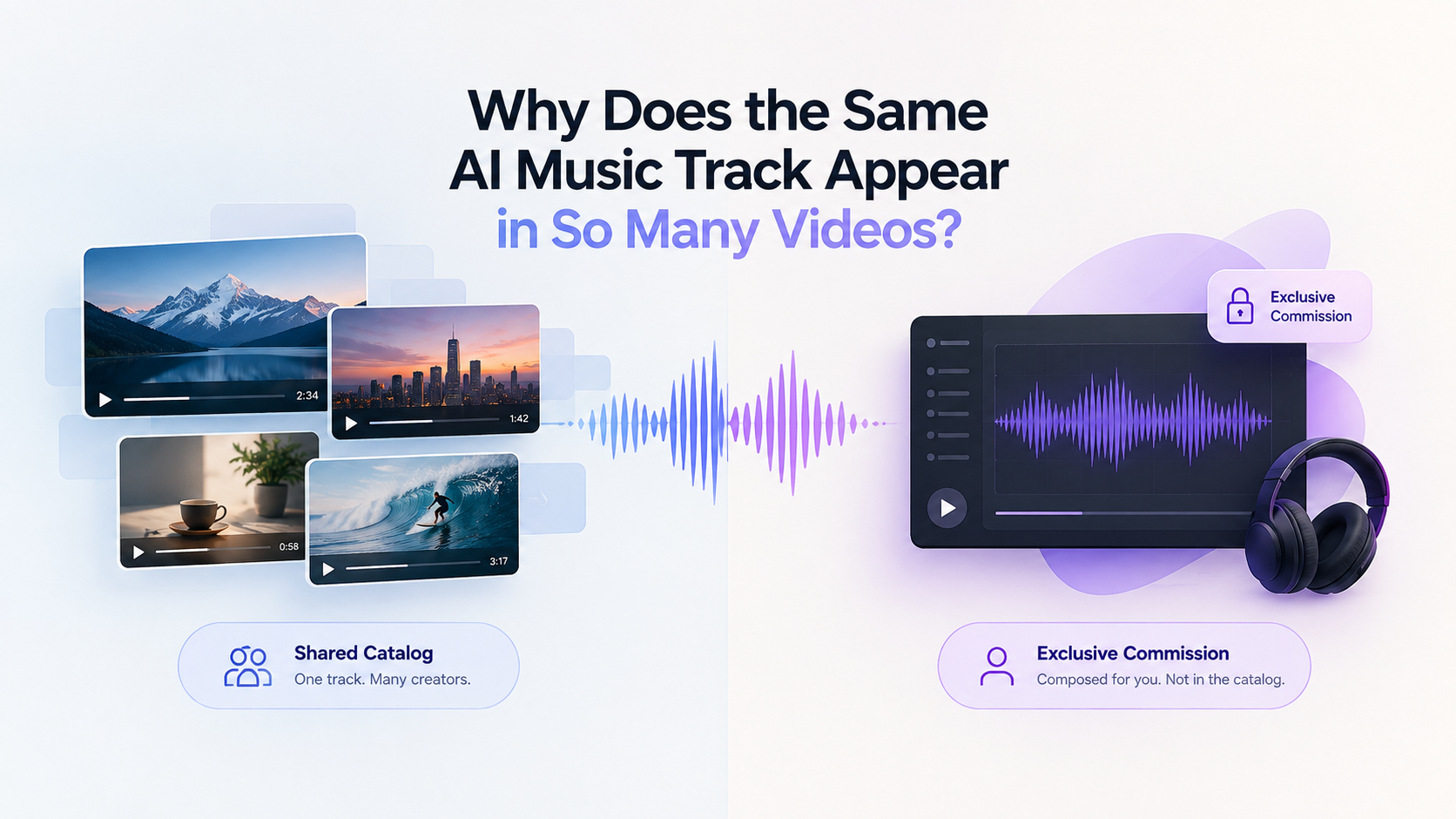
You find a track that fits your video perfectly. You use it, publish the project, and move on.
Then a few weeks later, you hear the exact same music in someone else's video.
It can feel strange, especially with AI music. If the track was generated rather than pulled from a traditional stock library, why is someone else using it too?
The answer comes down to how the music is licensed and distributed.
A track can be AI-generated, commercially licensed, and still be available for other creators to use. That is not necessarily a problem. In fact, it is an intentional part of a shared music catalog.
The important question is whether you need music that fits your project or music that is reserved for your project alone.
AI Music Changes How Stock Music Can Work
Traditional stock music generally starts with a finished composition that is uploaded to a library and licensed to users.
AI music introduces another possibility: music can be generated based on a description of what a creator needs.
Instead of searching for something tagged "corporate", "uplifting", or "cinematic", you can describe the actual moment:
"A restrained electronic track for a product reveal that starts minimal and builds into a confident ending."
The music can then be matched or composed around that description.
TheStockMusic is built around this model. Its catalog is searchable through full track descriptions rather than relying only on tags, and when there is no suitable match, an original instrumental can be composed from the request.
But there is an important consequence to this kind of growing AI music catalog.
The same track can be useful to more than one creator.
Why Can Two Creators Legally Use the Same Track?
Because a commercial-use license and exclusive use are not the same thing.
TheStockMusic describes its shared catalog as available through a subscription, with tracks described as instrumental, royalty-free, and cleared for commercial use. It also provides a license certificate with each download.
So if Creator A downloads a track from the shared catalog and uses it in a commercial video, that does not automatically prevent Creator B from licensing and using that same track.
The music is shared.
That is different from commissioning a track specifically for one project.
And this distinction matters even more with AI-generated music because a catalog can grow from tracks generated by creators themselves. TheStockMusic states that tracks creators generate join its library, allowing the catalog to continue growing around the kinds of music people are looking for.
So yes, you might hear the same AI music track somewhere else.
That does not, by itself, mean something went wrong.
When Is Shared AI Music Completely Fine?
For many types of content, having a track that someone else can also license is not particularly important.
Think about:
YouTube videos
Tutorials
Explainer videos
Social content
Presentations
Background music
Documentary-style content
Other projects where music supports the content rather than defining the brand
In these cases, the primary question is usually:
Does this track work for my video, and do I have the rights to use it?
If the answer is yes, a shared track can do the job.
The fact that another creator could also use it does not automatically change what you can do with your own licensed use.
But What If the Music Is Part of the Brand?
Now consider a different situation.
A company is launching a major campaign. A brand film has been carefully produced around a particular sound. A product commercial uses music as a recognizable part of its identity.
Here, hearing the exact same track in another company's campaign can be a different experience.
The issue isn't necessarily whether either creator is using the music legitimately.
The issue is distinctiveness.
If you want the music itself to be something that other users of the shared catalog are not going to encounter as an available track, a shared license isn't designed for that purpose.
That's where an exclusive commission comes in.
What Does an Exclusive AI Music Commission Actually Mean?
An exclusive commission is a different model from selecting an existing shared track.
You describe what you need, and an original instrumental is composed specifically for you.
TheStockMusic describes this option as an exclusive track that is composed for the customer and "never listed" in the shared catalog.
That gives you a different kind of relationship with the music.
With a shared track:
You find it → license it → use it.
With an exclusive commission:
You describe what you need → the music is composed for you → it isn't placed in the shared catalog.
Neither model has to replace the other.
They solve different problems.
One Important Distinction: Exclusivity Isn't the Same as Copyright Ownership
This is where AI music discussions can become unnecessarily confusing.
There are several different concepts involved in using AI-generated music: permission to use the platform, permission to use the resulting audio commercially, copyright ownership, and rights in any source material used during the process.
Those are not interchangeable.
As discussed in Melogen Studio's guide to commercial use and copyright in AI music, commercial-use permission does not automatically mean copyright ownership. The guide also notes that purely machine-generated output can raise separate questions about copyright protection, while rights in source material remain relevant when existing audio is used as an input.
That distinction matters here.
When The Stock Music says an exclusive commissioned track is composed for you and never listed in the shared catalog, the clearest meaning is catalog exclusivity. It should not automatically be interpreted as a blanket statement that you receive every possible form of copyright ownership over AI-generated music.
In other words:
"Not available to other catalog users" and "I own exclusive copyright in this music" are two different claims.
Keeping those concepts separate makes the whole AI music licensing conversation much easier to understand.
And What About Similar-Sounding Music?
There is another limit to exclusivity worth being honest about.
An exclusive track does not mean nobody else can ever create music with a similar mood, instrumentation, tempo, or musical character.
Music has recurring building blocks. Two completely independent compositions can both be atmospheric, piano-driven, tense, cinematic, minimal, or upbeat without either one being the same recording.
So exclusivity should not be understood as a guarantee that your project's musical style can never exist anywhere else.
The more precise distinction is:
A shared track is available to other users of the catalog.
An exclusive commissioned track is composed for you and not placed in that shared catalog.
That is the useful difference.
So, Should You Use Shared or Exclusive AI Music?
It depends on what the project needs from its music.
If you simply need the right sound for a video, a shared catalog can give you a practical way to find and license it.
If the music needs to have a more dedicated role in a brand, campaign, or other project where you don't want that specific track appearing as another available catalog option, an exclusive commission serves a different purpose.
The two approaches can comfortably exist side by side.
Shared AI music gives you access to a growing library of ready-to-use tracks.
Exclusive AI music gives you a track composed for your project and kept out of that shared library.
And that brings us back to the original question.
Why does the same stock track appear in so many videos?
Because shared licensing means multiple creators can legitimately use the same track.
Is that a problem?
Not necessarily.
It depends on whether your priority is simply finding music that fits your content, or having a specific track that isn't offered to other users of the catalog.
With AI music, the interesting part is that you don't necessarily have to choose one model forever.